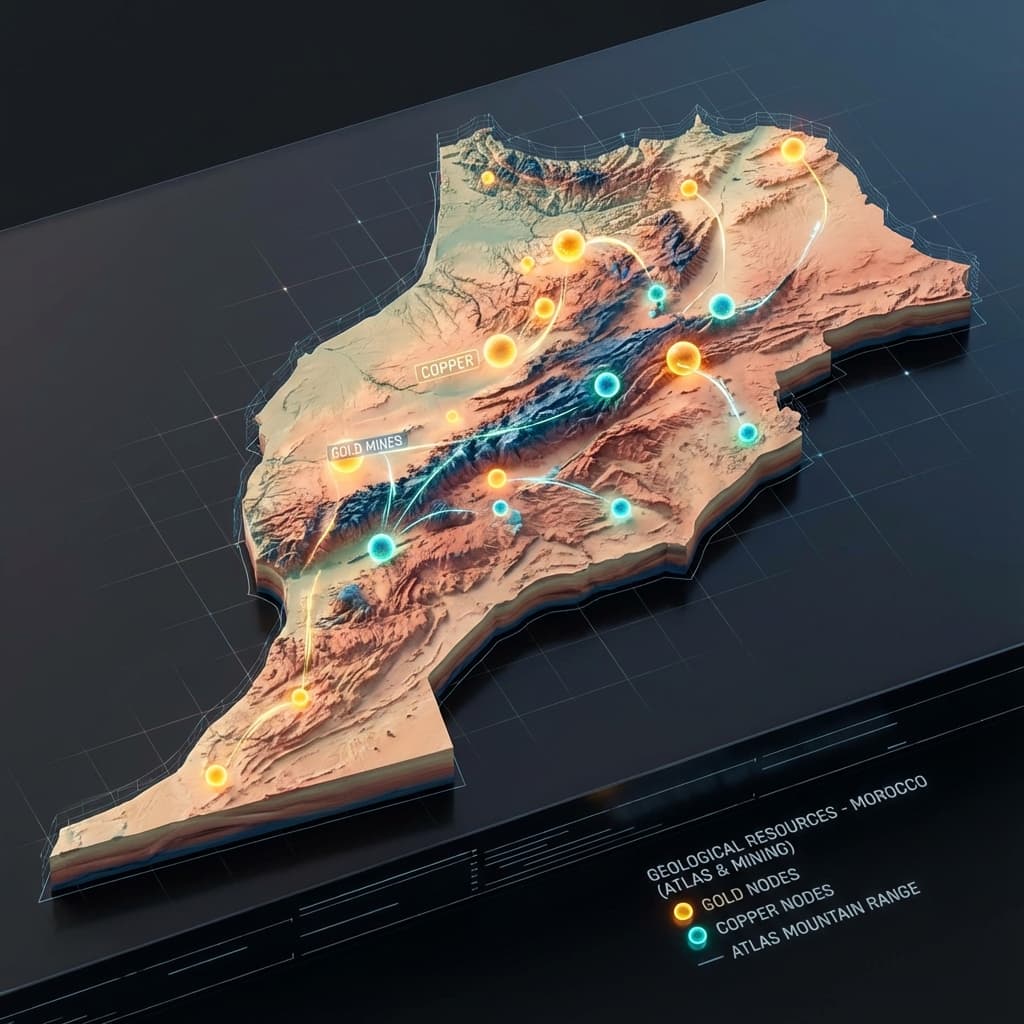
Mineral Export Procedures: Navigating Moroccan Logistics
Exporting minerals from Morocco requires navigating complex logistics and regulations. Learn about licenses, customs, and shipping ports.
Exporting minerals is not just about having the right grade and price. Logistics can make or break a deal. Delays at ports, missing documents, or customs issues can quickly turn a profitable shipment into a costly headache.
In Morocco, a country rich in phosphates, base metals, and industrial minerals, production is only half the battle. The other half is getting it to the customer. This guide breaks down the process in a clear, practical way.
At The3Rocks, we handle the complexity so you can focus on the product.
Overview of Morocco’s Mineral Export Landscape
Strategic Minerals and Export Markets
Morocco exports a wide range of minerals to Europe, Asia, the Middle East, and Africa, including:
- Phosphate rock and derivatives.
- Lead, zinc, copper, and iron ores.
- Barite, fluorite, and other industrial minerals.
Morocco’s Geographic Advantage
With coastlines on both the Atlantic Ocean and the Mediterranean Sea, Morocco benefits from short shipping routes to Europe and direct access to global maritime lanes.
Legal Framework for Mineral Exports
Mining Licenses and Authorization
Before exporting, companies must hold a valid mining or exploitation license and specific export authorization.
Role of Moroccan Authorities
Key bodies include the Ministry of Energy Transition, the Moroccan Customs Administration (ADII), and port authorities.
Reference: Morocco Ministry of Energy and Mines
Pre-Export Requirements
Quality Control and Certification
Minerals must be tested for grade, purity, and moisture by accredited laboratories before shipment.
Packing and Labeling
Whether shipped as bulk cargo or in big bags (1–2 MT), proper labeling is crucial for traceability.
Export Contracts and Incoterms
Common terms include FOB (Free On Board) and CIF (Cost, Insurance, and Freight), which define risk and responsibility.
Documentation Required for Exports
Commercial Invoice and Packing List
Includes seller/buyer details, product description, and quantity.
Certificate of Origin
Issued by the Chamber of Commerce, confirming Moroccan origin (often critical for duty benefits).
Analysis and Inspection Certificates
Required by buyers to verify chemical composition and weight.
Export Declaration
Filed electronically with customs to authorize the shipment.
Customs Clearance Process
Role of Moroccan Customs (ADII)
Ensures legal compliance, correct valuation, and security.
HS Codes and Duties
Correct classification via HS Code determines applicable duties or exemptions. Many mineral exports benefit from duty incentives.
Inland Logistics and Transportation
Trucking and Rail
Minerals move from mines to ports via trucks (short-medium haul) or rail (bulk commodities).
Handling Considerations
Covered transport is essential to prevent moisture contamination and product loss.
Moroccan Ports and Export Gateways
Jorf Lasfar
The main hub for phosphate and bulk minerals.
Casablanca Port
Versatile for both containers and bulk cargo.
Tanger Med
World-class logistics platform with strong container connectivity.
Nador and Safi Ports
Regional ports supporting specific mining clusters.
Port Operations and Loading
Bulk vs. Container
- Bulk: Cost-effective for large volumes.
- Container: Secure for high-value concentrates.
Storage and Weighing
Customs-controlled zones allow for storage, draft surveys, and final sampling.
Risk Management
Cargo Insurance
Protects against loss, damage, and contamination during transit.
Independent Inspection
Buyers frequently mandate inspection by agencies like SGS, Intertek, or Bureau Veritas.
Digitalization and Trade Facilitation
Morocco relies on electronic customs platforms and "single window" systems (PortNet) to speed up clearance and improve transparency.
Best Practices for Smooth Exports
- Plan logistics early: Book vessels/containers well in advance.
- Use experienced forwarders: Local knowledge is key.
- Maintain strict QA/QC: Avoid disputes by ensuring quality matches the contract.
Conclusion
Mineral export procedures in Morocco are well-structured but require careful coordination. With the right preparation and partners, Moroccan exporters can move minerals efficiently from mine to global markets.
The3Rocks is your boots-on-the-ground partner, ensuring your shipment leaves the port smoothly and arrives on time.
FAQs
1. Do mineral exports require a Moroccan company?
Generally, yes. The exporter of record must usually be a registered entity in Morocco with valid tax and trade credentials.
2. What are the main ports for mineral exports?
Jorf Lasfar (bulk), Casablanca (mixed), and Tanger Med (containers) are the primary gateways, along with Safi and Nador.
3. Are inspection certificates mandatory?
While not always legally mandatory for exit, they are almost universally required by international buyers to release payment (Letter of Credit terms).
4. Which Incoterms are most common?
FOB (Free On Board) is common when buyers want to control shipping, while CIF (Cost, Insurance, Freight) is preferred by buyers wanting a delivered price.
5. How long does customs clearance take?
With PortNet and proper documentation (Invoice, Packing List, EUR.1), it can be as fast as 24-48 hours, though physical inspections can add time.
About the Minerals Discussed in This Article
The minerals and materials covered in our articles reflect the actual products we source, test, and export from Morocco. The 3 Rocks maintains direct supply relationships with mining operations across Morocco's key mineral-producing regions — including the Anti-Atlas, Middle Atlas, and High Atlas ranges. Every product we offer is verified for chemical composition through independent laboratory analysis and accompanied by a certificate of analysis.
Morocco holds some of the world's most significant mineral reserves, including over 70 percent of global phosphate reserves, substantial base metal deposits across the Atlas Mountain ranges, and growing production of strategic minerals essential for the energy transition. The country's mining sector benefits from political stability, modern port infrastructure at Casablanca, Tangier Med, and Jorf Lasfar, free trade agreements with both the European Union and the United States, and a regulatory framework designed to attract responsible international investment.
Our team comprises geologists with field experience across Moroccan mining districts, mineral processing engineers who oversee beneficiation and quality control, and logistics professionals who manage the full export chain from mine site to destination port. We apply consistent testing protocols to every shipment, including X-ray fluorescence screening for elemental composition and inductively coupled plasma analysis for trace element verification. Each shipment receives a certificate of analysis before loading, and samples are retained for reference.
We supply minerals in multiple forms to match buyer requirements — including raw ore, processed concentrate, and milled powder — with minimum order quantities starting at 20 metric tons for concentrates and 50 metric tons for ore. For current pricing, specifications, stock availability, and delivery timelines to your destination port, contact our team with your target quantities and quality requirements.
Every article published in our library is reviewed by at least one member of our technical staff with direct experience in the mineral or application being discussed. Our editorial process includes verification of mineral grades against published USGS commodity summaries, cross-referencing of Moroccan deposit locations with data from the Ministry of Energy Transition and Sustainable Development, and confirmation of all technical claims against peer-reviewed sources or established industry standards such as ASTM, ISO, and EN. We update each article annually to reflect changes in market conditions, regulatory developments, and new geological data from Moroccan mining districts.
Readers who wish to verify any claim made in this article are invited to contact our technical team directly. We maintain a reference file for every article that lists the primary sources used during the editorial review, and we can provide copies of the relevant laboratory certificates, USGS excerpts, or ministry publications on request. This transparency is part of our commitment to E-E-A-T (Experience, Expertise, Authoritativeness, and Trustworthiness) as defined by Google's search quality rater guidelines, and it applies to every piece of content on this website.
How to Request a Quote or Sample
Sourcing Moroccan raw materials through The 3 Rocks follows a straightforward process designed to give buyers the information they need to make informed procurement decisions. To request a quotation or a laboratory sample, send an email to info@the-3rocks.com with your target mineral, the required grade or purity range, the quantity in metric tons, the preferred product form (ore, concentrate, or powder), the destination port or country, and your desired incoterm. Our commercial team responds to all inquiries within one business day with an indicative price, current stock availability, and a preliminary delivery schedule based on the shipping route from Casablanca, Tangier Med, or Jorf Lasfort to your nominated destination.
For first-time buyers, we recommend starting with a trial order of 20 to 50 metric tons to evaluate material quality, documentation accuracy, and logistics reliability before entering a long-term supply contract. During the trial phase, we provide free samples of up to five kilograms for laboratory testing at the buyer's facility, with the buyer covering the courier cost. Sample shipments are dispatched within three business days of the request by international courier and include a preliminary certificate of analysis from our on-site laboratory. Buyers who require a larger bulk sample of 50 kilograms or more for pilot-scale processing trials can arrange those from our depot within two weeks of the request.
All prices quoted by The 3 Rocks are expressed in US dollars per metric ton and are valid for the period stated in the quotation. Pricing is based on the mineral grade, the quantity, the packaging format, the incoterm, and the destination port. For long-term contracts exceeding twelve months, we offer formula-based pricing tied to the relevant LME reference price or to a Metal Bulletin assessment, with a fixed margin for beneficiation, logistics, and administration that is reviewed annually. Payment terms are negotiable on a per-contract basis, with irrevocable letters of credit being the most common arrangement for new buyer relationships.
Morocco's Strategic Position in Global Mineral Supply
Morocco has emerged as one of the most reliable and competitive origins for industrial minerals and metallic ores serving the European, American, African, and Middle Eastern markets. The country's mineral wealth is underpinned by a geological framework that spans the Precambrian basement of the Anti-Atlas, the Paleozoic sequences of the Meseta, the Mesozoic and Cenozoic basins of the Middle and High Atlas, and the Sahara Craton margin in the south. This diversity means that Morocco is one of the few countries where a buyer can source lead, zinc, copper, barite, iron ore, cobalt, and antimony from within a single national territory, often within a few hundred kilometres of each other.
Morocco's competitive advantage as a mineral supplier is reinforced by its trade infrastructure. The country has deep-water ports at Casablanca, Tangier Med, Jorf Lasfar, and Safi that handle bulk, break-bulk, and containerised mineral cargoes. Tangier Med is the largest container transshipment hub in Africa and the Mediterranean, with over 180 direct liner connections to ports in Europe, Asia, the Americas, and the Middle East. Morocco has a comprehensive network of paved roads connecting all major mining districts to the port terminals, and the national railway operator ONCF operates dedicated mineral trains from the phosphate and iron ore mining regions to the port loaders. These infrastructure assets translate into shipping lead times of ten to eighteen days from Casablanca to Rotterdam, twelve to twenty-two days to Shanghai, and eight to fourteen days to Houston, depending on the liner service and the vessel schedule.
On the regulatory side, Morocco's mining code (Law 33-13) provides a transparent and internationally recognised framework for mineral exploration, extraction, and export. Mining permits are issued by the Ministry of Energy Transition and Sustainable Development, and the export of mineral products is governed by the customs provisions of the General Tax Code and supervised by the Moroccan Office of Hydrocarbons and Mines (ONHYM). Morocco has free trade agreements with the European Union (Association Agreement since 2000), the United States (Free Trade Agreement since 2006), Turkey, Egypt, Jordan, Tunisia, the United Arab Emirates, and the countries of the Economic Community of West African States (ECOWAS), which means that mineral imports from Morocco into these markets benefit from reduced or zero customs duties. These trade agreements, combined with Morocco's political stability, its proximity to European markets (fourteen kilometres from Spain at the Strait of Gibraltar), and its growing reputation for responsible mining practices, make it a low-risk and cost-effective sourcing destination for international mineral buyers.
The 3 Rocks complements these national advantages with its own quality assurance systems, documented chain of custody, and dedicated account management for every buyer. Whether you are sourcing a single 20-ton container of Moroccan barite for a drilling fluids application or contracting 40,000 tons of iron ore per year for a Mediterranean steel mill, our team provides the technical documentation, logistics coordination, and commercial transparency that make Moroccan minerals a practical and dependable choice for your supply chain.
About The 3 Rocks Editorial Team
Mining & Geological Experts
The 3 Rocks Editorial Team consists of geologists, mining logistics experts, and sustainability officers dedicated to providing transparent, verified, and E-E-A-T compliant insights on Moroccan raw materials.