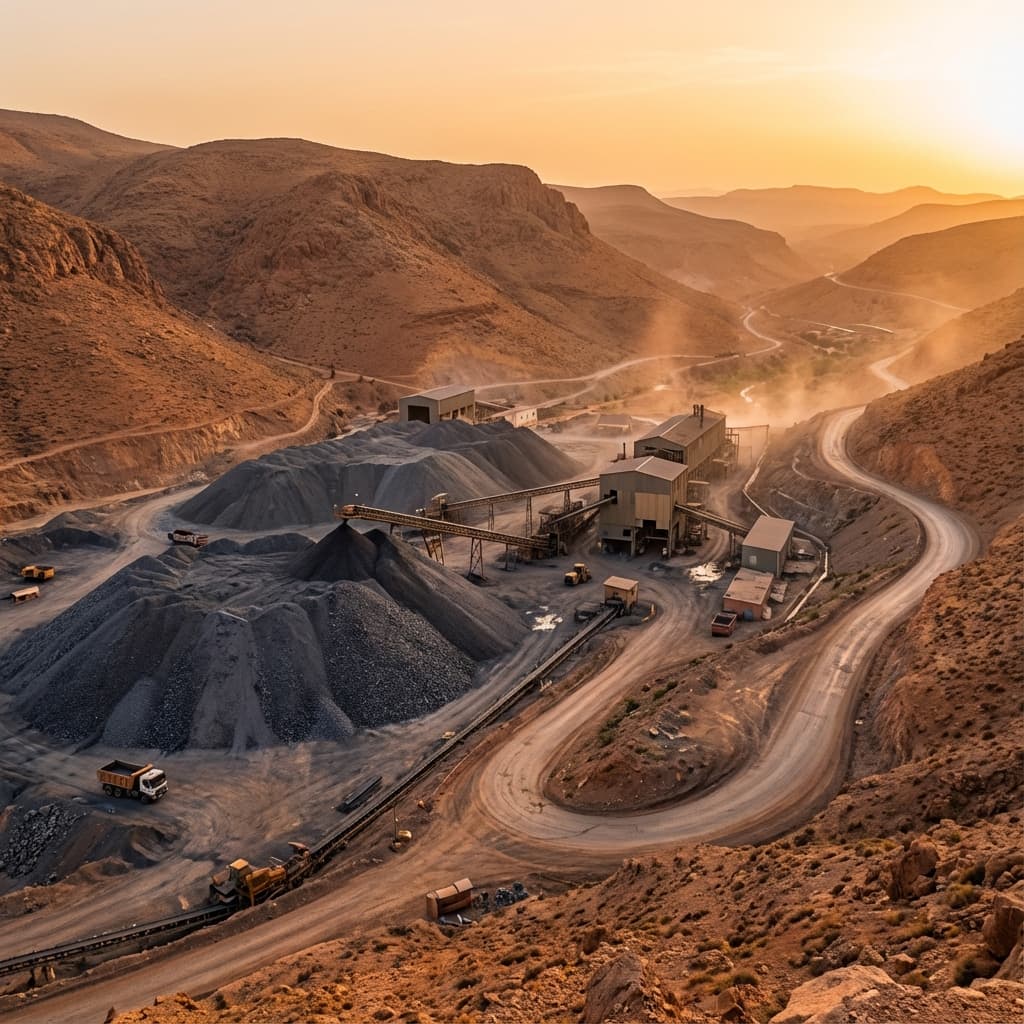
Mine Remediation Practices: Restoring the Land
Healing the scars of mining. From soil stabilization to phytoremediation, learn how modern techniques are restoring ecosystems in Morocco and beyond.
Mining has powered human progress for centuries, supplying the metals and minerals that build cities, fuel industries, and drive technology. But once the ores are extracted, what’s left behind can be a damaged landscape—polluted soils, contaminated water, and unsafe landforms.
This is where mine remediation steps in. Think of it as environmental healing—repairing the land after mining so nature and communities can thrive again. In countries with rich mining histories, including Morocco, mine remediation is becoming a critical pillar of sustainable development.
At The3Rocks, we believe that a mine's legacy should be measured not just by what is taken out, but by what is left behind.
What Is Mine Remediation?
Definition and Objectives
Mine remediation refers to the process of cleaning, stabilizing, and restoring mining-affected land to reduce environmental and health risks. The main goals are:
- Prevent contamination of soil and water.
- Stabilize landforms and prevent erosion.
- Restore ecosystems and biodiversity.
- Enable safe land reuse.
Remediation vs Rehabilitation vs Reclamation
These terms are often mixed up, but they have distinct meanings:
- Remediation: Removing or neutralizing contamination.
- Rehabilitation: Improving land to a stable and safe condition.
- Reclamation: Returning land to productive use (agriculture, forestry, housing).
Together, they form a complete mine closure and restoration strategy.
Environmental Impacts of Mining
Soil Degradation and Contamination
Mining disturbs soil structure and can introduce heavy metals like lead, arsenic, cadmium, and mercury. Acidic residues can limit plant growth and degrade nutrient levels.
Water Pollution and Acid Mine Drainage
One of the most serious impacts is acid mine drainage (AMD), which occurs when sulfide minerals react with water and oxygen, producing acidic water that dissolves toxic metals.
Air Quality and Dust Emissions
Windblown dust from tailings can affect respiratory health and spread contaminants far from the mine site.
Regulatory Framework and Standards
Mine remediation follows global frameworks such as ISO 14001 and World Bank guidelines.
National Regulations
Countries require mining companies to submit mine closure plans and provide financial guarantees. In Morocco, the Ministry of Energy and Mines mandates environmental impact assessments (EIA) to ensure long-term protection.
Reference: Morocco Ministry of Energy and Mines
Key Mine Remediation Techniques
Landform Reshaping and Stabilization
- Regrading slopes to prevent landslides.
- Stabilizing waste dumps.
- Reducing erosion and surface runoff.
Soil Replacement and Amendment
- Adding clean topsoil.
- Mixing organic matter and nutrients.
- Immobilizing heavy metals with lime or phosphate.
View our Sustainable Agriculture Solutions
Water Treatment Systems
- Passive systems: Constructed wetlands.
- Active treatment: Chemical neutralization to prevent metal-rich water from entering ecosystems.
Chemical and Biological Remediation Methods
Phytoremediation
Uses plants to absorb or stabilize contaminants. It is cost-effective and environmentally friendly, ideal for large, low-contamination areas.
Bioremediation Using Microorganisms
Bacteria can neutralize acidity or immobilize metals, offering a sustainable, low-energy solution for AMD treatment.
Chemical Neutralization
Lime and alkaline materials raise soil pH, reducing metal mobility and improving conditions for plant growth.
Tailings and Waste Rock Management
Tailings Storage Facility Rehabilitation
Reshaping and capping tailings dams is critical for long-term stability and to prevent dust and water infiltration.
Cover Systems
Soil, clay, or synthetic liners isolate contaminants from the environment, reducing oxygen and water exposure.
Mine Closure Planning
Progressive Rehabilitation
Remediation should start during mining, not after. This reduces long-term costs and speeds up environmental recovery.
Long-Term Monitoring
Continuous monitoring of water quality, vegetation success, and structural integrity is essential.
Mine Remediation in Morocco
Legacy Mining Sites
Morocco has historical mines for lead, zinc, antimony, copper, and iron. Many older sites require remediation to meet modern standards.
National Initiatives
Government-led rehabilitation programs, often in collaboration with universities, integrate remediation into the Vision 2030 mining strategy.
Socio-Economic Benefits of Remediation
Community Safety and Health
- Reduced exposure to toxic metals.
- Safer land for housing and agriculture.
- Improved water quality.
Land Reuse
- Conversion to farmland, parks, or industrial zones.
- Job creation in remediation and monitoring.
Innovations in Mine Remediation
- Remote Sensing: Satellite imagery tracks vegetation recovery.
- Nature-Based Solutions: Constructed wetlands and biochar amendments.
Case Studies of Successful Remediation
- Reclaimed phosphate mines transformed into agricultural land.
- Wetland systems effectively treating acid mine drainage.
- Reforested tailings sites supporting the return of local wildlife.
Conclusion
Mine remediation is not just an environmental obligation—it’s an investment in the future. By restoring contaminated land, protecting water resources, and rebuilding ecosystems, remediation turns former mine sites into safe, productive landscapes.
In Morocco and beyond, modern remediation practices are helping balance mineral development with environmental responsibility. The3Rocks is proud to champion these sustainable practices.
FAQs
1. What is the main goal of mine remediation?
To reduce environmental and health risks while restoring the land to a stable, safe, and potentially productive condition for future use.
2. How long does mine remediation take?
It is a long-term process that can take years or even decades, depending on the severity of contamination and the ecosystem's recovery rate.
3. What is acid mine drainage (AMD)?
AMD is highly acidic water rich in heavy metals, formed when sulfide minerals in mining waste are exposed to air and water. It is a major pollutant.
4. Can remediated land be reused?
Yes, successfully remediated land can often be repurposed for agriculture, forestry, recreational parks, or even industrial development.
5. Is mine remediation mandatory?
In strict regulatory environments like Morocco's current mining code, yes—operators are legally required to plan and fund remediation.
About the Minerals Discussed in This Article
The minerals and materials covered in our articles reflect the actual products we source, test, and export from Morocco. The 3 Rocks maintains direct supply relationships with mining operations across Morocco's key mineral-producing regions — including the Anti-Atlas, Middle Atlas, and High Atlas ranges. Every product we offer is verified for chemical composition through independent laboratory analysis and accompanied by a certificate of analysis.
Morocco holds some of the world's most significant mineral reserves, including over 70 percent of global phosphate reserves, substantial base metal deposits across the Atlas Mountain ranges, and growing production of strategic minerals essential for the energy transition. The country's mining sector benefits from political stability, modern port infrastructure at Casablanca, Tangier Med, and Jorf Lasfar, free trade agreements with both the European Union and the United States, and a regulatory framework designed to attract responsible international investment.
Our team comprises geologists with field experience across Moroccan mining districts, mineral processing engineers who oversee beneficiation and quality control, and logistics professionals who manage the full export chain from mine site to destination port. We apply consistent testing protocols to every shipment, including X-ray fluorescence screening for elemental composition and inductively coupled plasma analysis for trace element verification. Each shipment receives a certificate of analysis before loading, and samples are retained for reference.
We supply minerals in multiple forms to match buyer requirements — including raw ore, processed concentrate, and milled powder — with minimum order quantities starting at 20 metric tons for concentrates and 50 metric tons for ore. For current pricing, specifications, stock availability, and delivery timelines to your destination port, contact our team with your target quantities and quality requirements.
Every article published in our library is reviewed by at least one member of our technical staff with direct experience in the mineral or application being discussed. Our editorial process includes verification of mineral grades against published USGS commodity summaries, cross-referencing of Moroccan deposit locations with data from the Ministry of Energy Transition and Sustainable Development, and confirmation of all technical claims against peer-reviewed sources or established industry standards such as ASTM, ISO, and EN. We update each article annually to reflect changes in market conditions, regulatory developments, and new geological data from Moroccan mining districts.
Readers who wish to verify any claim made in this article are invited to contact our technical team directly. We maintain a reference file for every article that lists the primary sources used during the editorial review, and we can provide copies of the relevant laboratory certificates, USGS excerpts, or ministry publications on request. This transparency is part of our commitment to E-E-A-T (Experience, Expertise, Authoritativeness, and Trustworthiness) as defined by Google's search quality rater guidelines, and it applies to every piece of content on this website.
How to Request a Quote or Sample
Sourcing Moroccan raw materials through The 3 Rocks follows a straightforward process designed to give buyers the information they need to make informed procurement decisions. To request a quotation or a laboratory sample, send an email to info@the-3rocks.com with your target mineral, the required grade or purity range, the quantity in metric tons, the preferred product form (ore, concentrate, or powder), the destination port or country, and your desired incoterm. Our commercial team responds to all inquiries within one business day with an indicative price, current stock availability, and a preliminary delivery schedule based on the shipping route from Casablanca, Tangier Med, or Jorf Lasfort to your nominated destination.
For first-time buyers, we recommend starting with a trial order of 20 to 50 metric tons to evaluate material quality, documentation accuracy, and logistics reliability before entering a long-term supply contract. During the trial phase, we provide free samples of up to five kilograms for laboratory testing at the buyer's facility, with the buyer covering the courier cost. Sample shipments are dispatched within three business days of the request by international courier and include a preliminary certificate of analysis from our on-site laboratory. Buyers who require a larger bulk sample of 50 kilograms or more for pilot-scale processing trials can arrange those from our depot within two weeks of the request.
All prices quoted by The 3 Rocks are expressed in US dollars per metric ton and are valid for the period stated in the quotation. Pricing is based on the mineral grade, the quantity, the packaging format, the incoterm, and the destination port. For long-term contracts exceeding twelve months, we offer formula-based pricing tied to the relevant LME reference price or to a Metal Bulletin assessment, with a fixed margin for beneficiation, logistics, and administration that is reviewed annually. Payment terms are negotiable on a per-contract basis, with irrevocable letters of credit being the most common arrangement for new buyer relationships.
Morocco's Strategic Position in Global Mineral Supply
Morocco has emerged as one of the most reliable and competitive origins for industrial minerals and metallic ores serving the European, American, African, and Middle Eastern markets. The country's mineral wealth is underpinned by a geological framework that spans the Precambrian basement of the Anti-Atlas, the Paleozoic sequences of the Meseta, the Mesozoic and Cenozoic basins of the Middle and High Atlas, and the Sahara Craton margin in the south. This diversity means that Morocco is one of the few countries where a buyer can source lead, zinc, copper, barite, iron ore, cobalt, and antimony from within a single national territory, often within a few hundred kilometres of each other.
Morocco's competitive advantage as a mineral supplier is reinforced by its trade infrastructure. The country has deep-water ports at Casablanca, Tangier Med, Jorf Lasfar, and Safi that handle bulk, break-bulk, and containerised mineral cargoes. Tangier Med is the largest container transshipment hub in Africa and the Mediterranean, with over 180 direct liner connections to ports in Europe, Asia, the Americas, and the Middle East. Morocco has a comprehensive network of paved roads connecting all major mining districts to the port terminals, and the national railway operator ONCF operates dedicated mineral trains from the phosphate and iron ore mining regions to the port loaders. These infrastructure assets translate into shipping lead times of ten to eighteen days from Casablanca to Rotterdam, twelve to twenty-two days to Shanghai, and eight to fourteen days to Houston, depending on the liner service and the vessel schedule.
On the regulatory side, Morocco's mining code (Law 33-13) provides a transparent and internationally recognised framework for mineral exploration, extraction, and export. Mining permits are issued by the Ministry of Energy Transition and Sustainable Development, and the export of mineral products is governed by the customs provisions of the General Tax Code and supervised by the Moroccan Office of Hydrocarbons and Mines (ONHYM). Morocco has free trade agreements with the European Union (Association Agreement since 2000), the United States (Free Trade Agreement since 2006), Turkey, Egypt, Jordan, Tunisia, the United Arab Emirates, and the countries of the Economic Community of West African States (ECOWAS), which means that mineral imports from Morocco into these markets benefit from reduced or zero customs duties. These trade agreements, combined with Morocco's political stability, its proximity to European markets (fourteen kilometres from Spain at the Strait of Gibraltar), and its growing reputation for responsible mining practices, make it a low-risk and cost-effective sourcing destination for international mineral buyers.
The 3 Rocks complements these national advantages with its own quality assurance systems, documented chain of custody, and dedicated account management for every buyer. Whether you are sourcing a single 20-ton container of Moroccan barite for a drilling fluids application or contracting 40,000 tons of iron ore per year for a Mediterranean steel mill, our team provides the technical documentation, logistics coordination, and commercial transparency that make Moroccan minerals a practical and dependable choice for your supply chain.
About The 3 Rocks Editorial Team
Mining & Geological Experts
The 3 Rocks Editorial Team consists of geologists, mining logistics experts, and sustainability officers dedicated to providing transparent, verified, and E-E-A-T compliant insights on Moroccan raw materials.